Buy kamagraonlinekopen.be ?
We are moving the project
kamagraonlinekopen.be .
Are you interested in purchasing the domain
kamagraonlinekopen.be ?
domain@kv-gmbh.de · 0541-91531010
Buy kamagraonlinekopen.be ?
What does "den Nagel auf den Kopf treffen" mean?
"Den Nagel auf den Kopf treffen" is a German idiom that translates to "to hit the nail on the head" in English. It is used to describe a situation where someone has made a very accurate or precise statement or observation. It signifies that someone has expressed a thought or idea in a way that perfectly captures the essence of a situation or problem. **
Does it say "von Montag den" or "vom Montag den"?
The correct phrase is "von Montag den." This is because "von" is a preposition meaning "from," and "Montag" is the day of the week. When combined, they form the phrase "von Montag den," meaning "from Monday the." On the other hand, "vom" is a contraction of "von dem," which would not be used in this context. **

Similar search terms for Den
Top-Angebote
Products related to Den:
-
What is the correct wording: "Den Lebensmittelpunkt verlegen" or "Den Lebensmittelpunkt verlagern"?
Both "Den Lebensmittelpunkt verlegen" and "Den Lebensmittelpunkt verlagern" are correct wordings in German. However, there is a slight difference in meaning between the two. "Verlegen" implies moving the center of life to a new location, while "verlagern" suggests shifting the center of life to a different area without specifying a new location. **
-
Where does the expression "Das geht den Menschen wie den Leuten" originate from?
The expression "Das geht den Menschen wie den Leuten" originates from the German language and is a common saying used to convey that something applies to everyone in the same way. It is often used to emphasize that a situation or experience is universal and affects people equally. The origin of the expression is not definitively known, but it has been used in German language and literature for many years. **
-
Is it "Ich habe den Fernseher eingeschaltet" or "Ich habe den Fernseher eingeschalten"?
The correct phrase is "Ich habe den Fernseher eingeschaltet." The verb "einschalten" is a separable verb, and in the perfect tense, the prefix "ein" is separated from the main verb "schalten" and placed at the end of the sentence. Therefore, the correct past participle form is "eingeschaltet." **
-
What is the meaning of the expression "den Wind aus den Segeln nehmen"?
The expression "den Wind aus den Segeln nehmen" is a German idiom that translates to "to take the wind out of someone's sails" in English. It means to undermine someone's confidence or momentum, to thwart their plans or efforts, or to deflate their enthusiasm. Essentially, it refers to the act of diminishing someone's advantage or power. **
What does "auf den" mean?
"Auf den" is a German prepositional phrase that translates to "on the" in English. It is used to indicate location or direction towards something. For example, "auf den Tisch" means "on the table" and "auf den Boden" means "on the floor." **
Does it say 'Gebt euch den neuen Song' or 'Gibt euch den neuen Song'?
The correct phrase is "Gebt euch den neuen Song." The verb "geben" conjugated for the imperative form in the second person plural is "gebt." This means "Give yourselves the new song." **
Top-Angebote
Products related to Den:
-
Missha All Around Safe Block Cotton Sun Stick crème solaire visage waterproof en stick SPF 50+ 17 gMissha All Around Safe Block Cotton Sun Stick, 17 g, Protection contre le rayonnement solaire pour femme, Protégez votre peau du vieillissement prématuré et des autres dégradations causées par le soleil. La peau délicate du visage est beaucoup plus sensible que celle du reste du corps. En outre, elle est exposée aux rayons du soleil toute l'année. C'est pourquoi il est important de ne pas sous-estimer sa protection. Le produit de bronzage Missha All Around Safe Block Cotton Sun Stick protège efficacement la peau de votre visage contre les rayons UV et vous aide ainsi à prévenir les coups de soleil ou l'apparition de taches pigmentaires et à diminuer l'élasticité de la peau, la perte de collagène et autres signes de l’âge. Le produit : minimise la production excessive de sébum cutané protège la peau contre le vieillissement prématuré apporte l’hydratation et les nutriments dont la peau a besoin protège la peau contre les rayons UVA et UVB application pratique et hygiénique apaise la peau irritée résiste à l’eau hypoallergénique Composition du produit : extrait de Gotu kola : restaure la barrière cutanée, la renforce, soutient les processus régénératifs, atténue les irritations, lutte contre les rougeurs et la sécheresse, présente des effets antioxydants, hydrate la peau, aide à prévenir le vieillissement cutané panthénol : exerce une action hydratante et apaisante, réduit les irritations, les rougeurs, la sécheresse et les sensations d’inconfort produit végétalien Mode d’emploi : Appliquez sur une peau propre avant l’exposition au soleil. Appliquez les solaires en quantités suffisantes et à plusieurs reprises.21,90 €*Shipping: 3,45 €Secure redirect to the provider
-
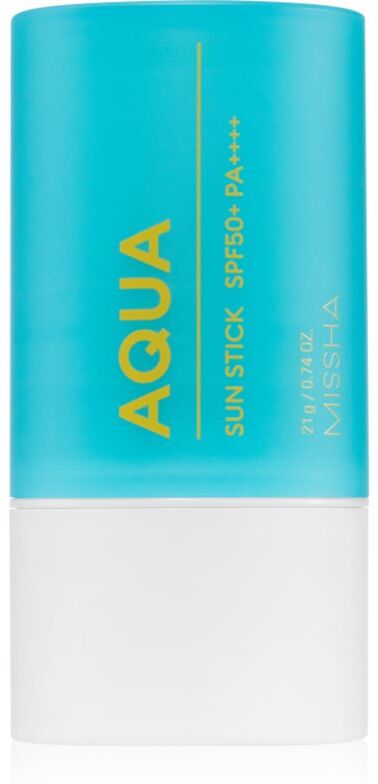
Missha All Around Safe Block Aqua Sun Stick crème solaire en stick pour une hydratation intense SPF 50+ 21 gMissha All Around Safe Block Aqua Sun Stick, 21 g, Protection contre le rayonnement solaire pour femme, Protégez votre peau du vieillissement prématuré et des autres dégradations causées par le soleil. La peau délicate du visage est beaucoup plus sensible que celle du reste du corps. En outre, elle est exposée aux rayons du soleil toute l'année. C'est pourquoi il est important de ne pas sous-estimer sa protection. Le produit de bronzage Missha All Around Safe Block Aqua Sun Stick protège efficacement la peau de votre visage contre les rayons UV et vous aide ainsi à prévenir les coups de soleil ou l'apparition de taches pigmentaires et à diminuer l'élasticité de la peau, la perte de collagène et autres signes de l’âge. Le produit : apaise la peau irritée et rougie protège la peau contre les rayons UVA et UVB application pratique et hygiénique réduction des taches pigmentaires donne de la fraîcheur et de la luminosité à votre peau rétracte les pores dilatés hydrate intensément unifie le teint de la peau nourrit en profondeur Composition du produit : niacinamide : augmente l’éclat de la peau, réduit les taches pigmentaires, unifie le teint, lisse les irrégularités de texture, aide à renforcer la barrière cutanée protectrice et à améliorer ainsi le niveau d’hydratation de la peau acide hyaluronique : fixe une grande quantité d’eau et hydrate intensément adénosine – possède des propriétés apaisantes et prévient les démangeaisons produit végétalien Mode d’emploi : Appliquez le produit environ 30 minutes avant d’exposer la peau aux rayons du soleil. Remettez-en une couche si nécessaire.21,90 €*Shipping: 3,45 €Secure redirect to the provider
-
What does "den Nagel auf den Kopf treffen" mean?
"Den Nagel auf den Kopf treffen" is a German idiom that translates to "to hit the nail on the head" in English. It is used to describe a situation where someone has made a very accurate or precise statement or observation. It signifies that someone has expressed a thought or idea in a way that perfectly captures the essence of a situation or problem. **
-
Does it say "von Montag den" or "vom Montag den"?
The correct phrase is "von Montag den." This is because "von" is a preposition meaning "from," and "Montag" is the day of the week. When combined, they form the phrase "von Montag den," meaning "from Monday the." On the other hand, "vom" is a contraction of "von dem," which would not be used in this context. **
-
What is the correct wording: "Den Lebensmittelpunkt verlegen" or "Den Lebensmittelpunkt verlagern"?
Both "Den Lebensmittelpunkt verlegen" and "Den Lebensmittelpunkt verlagern" are correct wordings in German. However, there is a slight difference in meaning between the two. "Verlegen" implies moving the center of life to a new location, while "verlagern" suggests shifting the center of life to a different area without specifying a new location. **
-
Where does the expression "Das geht den Menschen wie den Leuten" originate from?
The expression "Das geht den Menschen wie den Leuten" originates from the German language and is a common saying used to convey that something applies to everyone in the same way. It is often used to emphasize that a situation or experience is universal and affects people equally. The origin of the expression is not definitively known, but it has been used in German language and literature for many years. **
Similar search terms for Den
-
Is it "Ich habe den Fernseher eingeschaltet" or "Ich habe den Fernseher eingeschalten"?
The correct phrase is "Ich habe den Fernseher eingeschaltet." The verb "einschalten" is a separable verb, and in the perfect tense, the prefix "ein" is separated from the main verb "schalten" and placed at the end of the sentence. Therefore, the correct past participle form is "eingeschaltet." **
-
What is the meaning of the expression "den Wind aus den Segeln nehmen"?
The expression "den Wind aus den Segeln nehmen" is a German idiom that translates to "to take the wind out of someone's sails" in English. It means to undermine someone's confidence or momentum, to thwart their plans or efforts, or to deflate their enthusiasm. Essentially, it refers to the act of diminishing someone's advantage or power. **
-
What does "auf den" mean?
"Auf den" is a German prepositional phrase that translates to "on the" in English. It is used to indicate location or direction towards something. For example, "auf den Tisch" means "on the table" and "auf den Boden" means "on the floor." **
-
Does it say 'Gebt euch den neuen Song' or 'Gibt euch den neuen Song'?
The correct phrase is "Gebt euch den neuen Song." The verb "geben" conjugated for the imperative form in the second person plural is "gebt." This means "Give yourselves the new song." **
* All prices are inclusive of VAT and, if applicable, plus shipping costs. The offer information is based on the details provided by the respective shop and is updated through automated processes. Real-time updates do not occur, so deviations can occur in individual cases. ** Note: Parts of this content were created by AI.