Buy kamagraonlinekopen.be ?
We are moving the project
kamagraonlinekopen.be .
Are you interested in purchasing the domain
kamagraonlinekopen.be ?
domain@kv-gmbh.de · 0541-91531010
Buy kamagraonlinekopen.be ?
What are the differences between covalent bonds, metallic bonds, and ionic bonds?
Covalent bonds are formed when two atoms share electrons, resulting in a strong bond between the atoms. Metallic bonds occur between metal atoms, where the electrons are delocalized and free to move throughout the structure, creating a strong bond. Ionic bonds are formed between a metal and a nonmetal, where one atom transfers electrons to the other, resulting in the formation of positively and negatively charged ions that are attracted to each other. Overall, covalent bonds involve electron sharing, metallic bonds involve electron delocalization, and ionic bonds involve electron transfer. **
Do CO bonds form with other CO bonds?
No, CO bonds do not typically form with other CO bonds. Carbon monoxide (CO) is a stable molecule with a triple bond between the carbon and oxygen atoms. This triple bond is strong and does not readily form additional bonds with other CO molecules. Instead, CO molecules tend to interact with other types of molecules through various types of chemical reactions. **


Similar search terms for Bonds
Top-Angebote
Products related to Bonds:
-
Easytoys Online Only Draps de vinyle 180 x 230 cm - NoirPosez le Drap de vinyle 180 x 230 cm - Noir de Easytoys Online Only sur votre lit et transformez votre espace en un sanctuaire de détente. Ce drap est 100 % imperméable, vous protégeant ainsi des lubrifiants, huiles de massage et autres liquides. Vous pouvez l'utiliser non seulement sur votre lit29,99 €*Shipping: 0,00 €Secure redirect to the provider
-
Easytoys Online Only Moule à glaçons/moule à pâtisserie en forme de pénisTransformez vos moments de partage en véritables occasions de rire et de plaisir avec le moule à glaçons/moule à pâtisserie en forme de pénis de la marque Easytoys Online Only. Ce gadget amusant est idéal pour surprendre vos amis ou pimenter vos soirées avec une touche d'humour. Imaginez leurs12,99 €*Shipping: 3,90 €Secure redirect to the provider
-
Missha All Around Safe Block Cotton Sun Stick crème solaire visage waterproof en stick SPF 50+ 17 gMissha All Around Safe Block Cotton Sun Stick, 17 g, Protection contre le rayonnement solaire pour femme, Protégez votre peau du vieillissement prématuré et des autres dégradations causées par le soleil. La peau délicate du visage est beaucoup plus sensible que celle du reste du corps. En outre, elle est exposée aux rayons du soleil toute l'année. C'est pourquoi il est important de ne pas sous-estimer sa protection. Le produit de bronzage Missha All Around Safe Block Cotton Sun Stick protège efficacement la peau de votre visage contre les rayons UV et vous aide ainsi à prévenir les coups de soleil ou l'apparition de taches pigmentaires et à diminuer l'élasticité de la peau, la perte de collagène et autres signes de l’âge. Le produit : minimise la production excessive de sébum cutané protège la peau contre le vieillissement prématuré apporte l’hydratation et les nutriments dont la peau a besoin protège la peau contre les rayons UVA et UVB application pratique et hygiénique apaise la peau irritée résiste à l’eau hypoallergénique Composition du produit : extrait de Gotu kola : restaure la barrière cutanée, la renforce, soutient les processus régénératifs, atténue les irritations, lutte contre les rougeurs et la sécheresse, présente des effets antioxydants, hydrate la peau, aide à prévenir le vieillissement cutané panthénol : exerce une action hydratante et apaisante, réduit les irritations, les rougeurs, la sécheresse et les sensations d’inconfort produit végétalien Mode d’emploi : Appliquez sur une peau propre avant l’exposition au soleil. Appliquez les solaires en quantités suffisantes et à plusieurs reprises.21,90 €*Shipping: 3,45 €Secure redirect to the provider
-
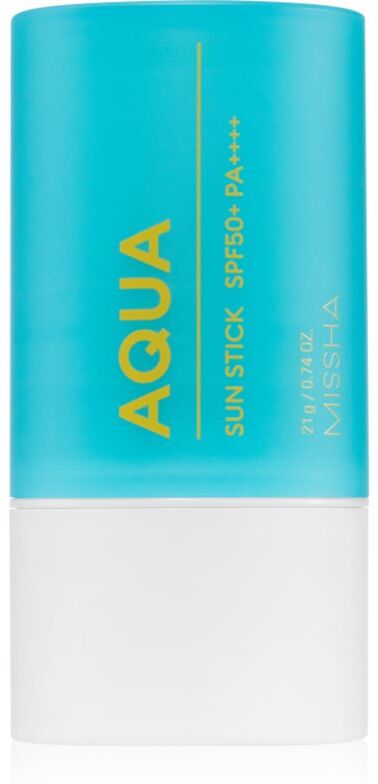
Missha All Around Safe Block Aqua Sun Stick crème solaire en stick pour une hydratation intense SPF 50+ 21 gMissha All Around Safe Block Aqua Sun Stick, 21 g, Protection contre le rayonnement solaire pour femme, Protégez votre peau du vieillissement prématuré et des autres dégradations causées par le soleil. La peau délicate du visage est beaucoup plus sensible que celle du reste du corps. En outre, elle est exposée aux rayons du soleil toute l'année. C'est pourquoi il est important de ne pas sous-estimer sa protection. Le produit de bronzage Missha All Around Safe Block Aqua Sun Stick protège efficacement la peau de votre visage contre les rayons UV et vous aide ainsi à prévenir les coups de soleil ou l'apparition de taches pigmentaires et à diminuer l'élasticité de la peau, la perte de collagène et autres signes de l’âge. Le produit : apaise la peau irritée et rougie protège la peau contre les rayons UVA et UVB application pratique et hygiénique réduction des taches pigmentaires donne de la fraîcheur et de la luminosité à votre peau rétracte les pores dilatés hydrate intensément unifie le teint de la peau nourrit en profondeur Composition du produit : niacinamide : augmente l’éclat de la peau, réduit les taches pigmentaires, unifie le teint, lisse les irrégularités de texture, aide à renforcer la barrière cutanée protectrice et à améliorer ainsi le niveau d’hydratation de la peau acide hyaluronique : fixe une grande quantité d’eau et hydrate intensément adénosine – possède des propriétés apaisantes et prévient les démangeaisons produit végétalien Mode d’emploi : Appliquez le produit environ 30 minutes avant d’exposer la peau aux rayons du soleil. Remettez-en une couche si nécessaire.21,90 €*Shipping: 3,45 €Secure redirect to the provider


-
Why are intermolecular bonds weaker than electron pair bonds?
Intermolecular bonds are weaker than electron pair bonds because they involve interactions between molecules rather than within a single molecule. In intermolecular bonds, the attractive forces between molecules are generally weaker than the covalent bonds that hold atoms together within a molecule. Additionally, intermolecular bonds are typically temporary and can be easily broken, whereas electron pair bonds are strong and stable. Overall, the weaker nature of intermolecular bonds allows molecules to move and interact with each other more freely. **
-
Why are intermolecular bonds generally weaker than covalent bonds?
Intermolecular bonds are generally weaker than covalent bonds because they involve interactions between molecules rather than within a single molecule. Covalent bonds involve the sharing of electrons between atoms, creating strong bonds within a molecule. In contrast, intermolecular bonds, such as hydrogen bonds or van der Waals forces, are weaker because they are based on temporary interactions between molecules, which can be easily broken. Additionally, intermolecular bonds are influenced by factors such as distance and orientation, further contributing to their weaker nature compared to covalent bonds. **
-
Why are intermolecular bonds typically weaker than covalent bonds?
Intermolecular bonds are typically weaker than covalent bonds because they involve interactions between molecules rather than within a single molecule. In intermolecular bonds, the attractive forces between molecules, such as van der Waals forces or hydrogen bonding, are weaker than the strong sharing of electrons in covalent bonds. Additionally, intermolecular bonds are more easily broken or disrupted by changes in temperature or pressure, leading to lower bond energies compared to covalent bonds. **
-
Why are polar bonds lower in energy than nonpolar bonds?
Polar bonds are lower in energy than nonpolar bonds because they involve the unequal sharing of electrons between two atoms with different electronegativities. This unequal sharing creates a dipole moment, which results in an attractive force between the partially positive and partially negative ends of the molecule. This electrostatic attraction lowers the overall energy of the molecule compared to nonpolar bonds, where electrons are shared equally. As a result, polar bonds are typically stronger and more stable than nonpolar bonds. **
Why are intermolecular bonds generally weaker than electron pair bonds?
Intermolecular bonds are generally weaker than electron pair bonds because they involve interactions between molecules, which are larger and less localized than the interactions between atoms in a covalent bond. In intermolecular bonds, the attractive forces are typically weaker due to the larger distance between molecules and the lack of direct sharing of electrons. In contrast, electron pair bonds involve the sharing of electrons between atoms, leading to stronger and more localized bonding interactions. **
Why are primary bonds stronger than secondary bonds in chemistry?
Primary bonds, such as covalent and ionic bonds, are stronger than secondary bonds, such as hydrogen bonds and van der Waals forces, because they involve the sharing or transfer of electrons between atoms. This results in a more stable and tightly held bond. In contrast, secondary bonds are based on weaker electrostatic interactions between molecules or atoms, such as dipole-dipole interactions or temporary induced dipoles, which are not as strong as the sharing or transfer of electrons in primary bonds. Therefore, primary bonds have a higher bond energy and require more energy to break compared to secondary bonds. **
Top-Angebote
Products related to Bonds:
-
Easytoys Online Only Moule à pâtisserie en forme de pénisLaissez libre cours à votre créativité culinaire avec le Moule à pâtisserie en forme de pénis de la marque Easytoys Online Only. Imaginez la surprise de vos convives ou de votre partenaire lorsque vous servirez un gâteau audacieux et amusant, confectionné avec ce moule unique. Fabriqué en silicone,19,99 €*Shipping: 3,90 €Secure redirect to the provider
-
Easytoys Online Only Draps de vinyle 180 x 230 cm - NoirPosez le Drap de vinyle 180 x 230 cm - Noir de Easytoys Online Only sur votre lit et transformez votre espace en un sanctuaire de détente. Ce drap est 100 % imperméable, vous protégeant ainsi des lubrifiants, huiles de massage et autres liquides. Vous pouvez l'utiliser non seulement sur votre lit29,99 €*Shipping: 0,00 €Secure redirect to the provider
-
Easytoys Online Only Moule à glaçons/moule à pâtisserie en forme de pénisTransformez vos moments de partage en véritables occasions de rire et de plaisir avec le moule à glaçons/moule à pâtisserie en forme de pénis de la marque Easytoys Online Only. Ce gadget amusant est idéal pour surprendre vos amis ou pimenter vos soirées avec une touche d'humour. Imaginez leurs12,99 €*Shipping: 3,90 €Secure redirect to the provider
-
What are the differences between covalent bonds, metallic bonds, and ionic bonds?
Covalent bonds are formed when two atoms share electrons, resulting in a strong bond between the atoms. Metallic bonds occur between metal atoms, where the electrons are delocalized and free to move throughout the structure, creating a strong bond. Ionic bonds are formed between a metal and a nonmetal, where one atom transfers electrons to the other, resulting in the formation of positively and negatively charged ions that are attracted to each other. Overall, covalent bonds involve electron sharing, metallic bonds involve electron delocalization, and ionic bonds involve electron transfer. **
-
Do CO bonds form with other CO bonds?
No, CO bonds do not typically form with other CO bonds. Carbon monoxide (CO) is a stable molecule with a triple bond between the carbon and oxygen atoms. This triple bond is strong and does not readily form additional bonds with other CO molecules. Instead, CO molecules tend to interact with other types of molecules through various types of chemical reactions. **
-
Why are intermolecular bonds weaker than electron pair bonds?
Intermolecular bonds are weaker than electron pair bonds because they involve interactions between molecules rather than within a single molecule. In intermolecular bonds, the attractive forces between molecules are generally weaker than the covalent bonds that hold atoms together within a molecule. Additionally, intermolecular bonds are typically temporary and can be easily broken, whereas electron pair bonds are strong and stable. Overall, the weaker nature of intermolecular bonds allows molecules to move and interact with each other more freely. **
-
Why are intermolecular bonds generally weaker than covalent bonds?
Intermolecular bonds are generally weaker than covalent bonds because they involve interactions between molecules rather than within a single molecule. Covalent bonds involve the sharing of electrons between atoms, creating strong bonds within a molecule. In contrast, intermolecular bonds, such as hydrogen bonds or van der Waals forces, are weaker because they are based on temporary interactions between molecules, which can be easily broken. Additionally, intermolecular bonds are influenced by factors such as distance and orientation, further contributing to their weaker nature compared to covalent bonds. **
Similar search terms for Bonds
-
Missha All Around Safe Block Cotton Sun Stick crème solaire visage waterproof en stick SPF 50+ 17 gMissha All Around Safe Block Cotton Sun Stick, 17 g, Protection contre le rayonnement solaire pour femme, Protégez votre peau du vieillissement prématuré et des autres dégradations causées par le soleil. La peau délicate du visage est beaucoup plus sensible que celle du reste du corps. En outre, elle est exposée aux rayons du soleil toute l'année. C'est pourquoi il est important de ne pas sous-estimer sa protection. Le produit de bronzage Missha All Around Safe Block Cotton Sun Stick protège efficacement la peau de votre visage contre les rayons UV et vous aide ainsi à prévenir les coups de soleil ou l'apparition de taches pigmentaires et à diminuer l'élasticité de la peau, la perte de collagène et autres signes de l’âge. Le produit : minimise la production excessive de sébum cutané protège la peau contre le vieillissement prématuré apporte l’hydratation et les nutriments dont la peau a besoin protège la peau contre les rayons UVA et UVB application pratique et hygiénique apaise la peau irritée résiste à l’eau hypoallergénique Composition du produit : extrait de Gotu kola : restaure la barrière cutanée, la renforce, soutient les processus régénératifs, atténue les irritations, lutte contre les rougeurs et la sécheresse, présente des effets antioxydants, hydrate la peau, aide à prévenir le vieillissement cutané panthénol : exerce une action hydratante et apaisante, réduit les irritations, les rougeurs, la sécheresse et les sensations d’inconfort produit végétalien Mode d’emploi : Appliquez sur une peau propre avant l’exposition au soleil. Appliquez les solaires en quantités suffisantes et à plusieurs reprises.21,90 €*Shipping: 3,45 €Secure redirect to the provider
-
Missha All Around Safe Block Aqua Sun Stick crème solaire en stick pour une hydratation intense SPF 50+ 21 gMissha All Around Safe Block Aqua Sun Stick, 21 g, Protection contre le rayonnement solaire pour femme, Protégez votre peau du vieillissement prématuré et des autres dégradations causées par le soleil. La peau délicate du visage est beaucoup plus sensible que celle du reste du corps. En outre, elle est exposée aux rayons du soleil toute l'année. C'est pourquoi il est important de ne pas sous-estimer sa protection. Le produit de bronzage Missha All Around Safe Block Aqua Sun Stick protège efficacement la peau de votre visage contre les rayons UV et vous aide ainsi à prévenir les coups de soleil ou l'apparition de taches pigmentaires et à diminuer l'élasticité de la peau, la perte de collagène et autres signes de l’âge. Le produit : apaise la peau irritée et rougie protège la peau contre les rayons UVA et UVB application pratique et hygiénique réduction des taches pigmentaires donne de la fraîcheur et de la luminosité à votre peau rétracte les pores dilatés hydrate intensément unifie le teint de la peau nourrit en profondeur Composition du produit : niacinamide : augmente l’éclat de la peau, réduit les taches pigmentaires, unifie le teint, lisse les irrégularités de texture, aide à renforcer la barrière cutanée protectrice et à améliorer ainsi le niveau d’hydratation de la peau acide hyaluronique : fixe une grande quantité d’eau et hydrate intensément adénosine – possède des propriétés apaisantes et prévient les démangeaisons produit végétalien Mode d’emploi : Appliquez le produit environ 30 minutes avant d’exposer la peau aux rayons du soleil. Remettez-en une couche si nécessaire.21,90 €*Shipping: 3,45 €Secure redirect to the provider
-
Why are intermolecular bonds typically weaker than covalent bonds?
Intermolecular bonds are typically weaker than covalent bonds because they involve interactions between molecules rather than within a single molecule. In intermolecular bonds, the attractive forces between molecules, such as van der Waals forces or hydrogen bonding, are weaker than the strong sharing of electrons in covalent bonds. Additionally, intermolecular bonds are more easily broken or disrupted by changes in temperature or pressure, leading to lower bond energies compared to covalent bonds. **
-
Why are polar bonds lower in energy than nonpolar bonds?
Polar bonds are lower in energy than nonpolar bonds because they involve the unequal sharing of electrons between two atoms with different electronegativities. This unequal sharing creates a dipole moment, which results in an attractive force between the partially positive and partially negative ends of the molecule. This electrostatic attraction lowers the overall energy of the molecule compared to nonpolar bonds, where electrons are shared equally. As a result, polar bonds are typically stronger and more stable than nonpolar bonds. **
-
Why are intermolecular bonds generally weaker than electron pair bonds?
Intermolecular bonds are generally weaker than electron pair bonds because they involve interactions between molecules, which are larger and less localized than the interactions between atoms in a covalent bond. In intermolecular bonds, the attractive forces are typically weaker due to the larger distance between molecules and the lack of direct sharing of electrons. In contrast, electron pair bonds involve the sharing of electrons between atoms, leading to stronger and more localized bonding interactions. **
-
Why are primary bonds stronger than secondary bonds in chemistry?
Primary bonds, such as covalent and ionic bonds, are stronger than secondary bonds, such as hydrogen bonds and van der Waals forces, because they involve the sharing or transfer of electrons between atoms. This results in a more stable and tightly held bond. In contrast, secondary bonds are based on weaker electrostatic interactions between molecules or atoms, such as dipole-dipole interactions or temporary induced dipoles, which are not as strong as the sharing or transfer of electrons in primary bonds. Therefore, primary bonds have a higher bond energy and require more energy to break compared to secondary bonds. **
* All prices are inclusive of VAT and, if applicable, plus shipping costs. The offer information is based on the details provided by the respective shop and is updated through automated processes. Real-time updates do not occur, so deviations can occur in individual cases. ** Note: Parts of this content were created by AI.