Buy kamagraonlinekopen.be ?
We are moving the project
kamagraonlinekopen.be .
Are you interested in purchasing the domain
kamagraonlinekopen.be ?
domain@kv-gmbh.de · 0541-91531010
Buy kamagraonlinekopen.be ?
How do you prove surjectivity?
To prove surjectivity, you need to show that for every element in the codomain, there exists at least one element in the domain that maps to it. One way to do this is by taking an arbitrary element in the codomain and finding a pre-image for it in the domain. If you can find a pre-image for every element in the codomain, then the function is surjective. Another approach is to show that the range of the function is equal to the codomain, indicating that every element in the codomain is being mapped to. **
How can one show surjectivity?
One can show surjectivity by demonstrating that every element in the codomain has a preimage in the domain. This can be done by showing that for every y in the codomain, there exists an x in the domain such that f(x) = y. In other words, the function "covers" the entire codomain, leaving no elements without a preimage. This can be shown through direct proof, by finding the specific preimage for each element in the codomain, or through a more general argument, such as showing that the function is onto. **

Similar search terms for Surjectivity
Top-Angebote
Products related to Surjectivity:
-
How can one check images for surjectivity?
One can check images for surjectivity by examining whether the range of the function covers the entire codomain. To do this, one can analyze the function's output for different input values and determine if every element in the codomain is covered. If the function's image covers the entire codomain, then the function is surjective. Another approach is to use the definition of surjectivity, which states that for every y in the codomain, there exists an x in the domain such that f(x) = y. By verifying this condition for all elements in the codomain, one can determine if the function is surjective. **
-
What is the injectivity and surjectivity of compositions?
The injectivity of compositions refers to the property of a composition of functions where if the composition of two functions is injective, then the outer function is injective. Similarly, the surjectivity of compositions refers to the property where if the composition of two functions is surjective, then the inner function is surjective. In other words, the injectivity and surjectivity of compositions are related to the properties of the individual functions within the composition. **
-
Is there no injectivity or no surjectivity here?
There is no surjectivity here. Surjectivity means that every element in the codomain is mapped to by at least one element in the domain. In this case, there are elements in the codomain that are not being mapped to by any element in the domain, so the function is not surjective. **
-
Why do we need injectivity, surjectivity, or bijectivity?
Injectivity, surjectivity, and bijectivity are important concepts in mathematics because they help us understand the relationship between different sets and functions. Injectivity ensures that each element in the domain maps to a unique element in the codomain, which is useful for preventing information loss in functions. Surjectivity guarantees that every element in the codomain is mapped to by at least one element in the domain, ensuring that no information is left out. Bijectivity combines these two properties, providing a one-to-one correspondence between elements in the domain and codomain, making it easier to establish relationships and solve problems in various mathematical contexts. **
How can one formally prove injectivity and surjectivity?
To formally prove injectivity, one must show that for any two distinct elements in the domain, their images under the function are also distinct. This can be done by assuming two elements in the domain that map to the same element in the codomain, and then showing that this assumption leads to a contradiction. To formally prove surjectivity, one must show that for every element in the codomain, there exists at least one element in the domain that maps to it. This can be done by taking an arbitrary element in the codomain and finding a pre-image for it in the domain. This process must be repeated for every element in the codomain to establish surjectivity. **
What methods do you know to prove surjectivity?
One method to prove surjectivity is to show that for every element in the codomain, there exists at least one element in the domain that maps to it. This can be done by explicitly finding the pre-image of each element in the codomain. Another method is to use the concept of range and show that the range of the function is equal to the codomain. Additionally, one can use the contrapositive of the definition of surjectivity, which states that if there exists an element in the codomain that does not have a pre-image in the domain, then the function is not surjective. **
Top-Angebote
Products related to Surjectivity:
-
Missha All Around Safe Block Cotton Sun Stick crème solaire visage waterproof en stick SPF 50+ 17 gMissha All Around Safe Block Cotton Sun Stick, 17 g, Protection contre le rayonnement solaire pour femme, Protégez votre peau du vieillissement prématuré et des autres dégradations causées par le soleil. La peau délicate du visage est beaucoup plus sensible que celle du reste du corps. En outre, elle est exposée aux rayons du soleil toute l'année. C'est pourquoi il est important de ne pas sous-estimer sa protection. Le produit de bronzage Missha All Around Safe Block Cotton Sun Stick protège efficacement la peau de votre visage contre les rayons UV et vous aide ainsi à prévenir les coups de soleil ou l'apparition de taches pigmentaires et à diminuer l'élasticité de la peau, la perte de collagène et autres signes de l’âge. Le produit : minimise la production excessive de sébum cutané protège la peau contre le vieillissement prématuré apporte l’hydratation et les nutriments dont la peau a besoin protège la peau contre les rayons UVA et UVB application pratique et hygiénique apaise la peau irritée résiste à l’eau hypoallergénique Composition du produit : extrait de Gotu kola : restaure la barrière cutanée, la renforce, soutient les processus régénératifs, atténue les irritations, lutte contre les rougeurs et la sécheresse, présente des effets antioxydants, hydrate la peau, aide à prévenir le vieillissement cutané panthénol : exerce une action hydratante et apaisante, réduit les irritations, les rougeurs, la sécheresse et les sensations d’inconfort produit végétalien Mode d’emploi : Appliquez sur une peau propre avant l’exposition au soleil. Appliquez les solaires en quantités suffisantes et à plusieurs reprises.21,90 €*Shipping: 3,45 €Secure redirect to the provider
-
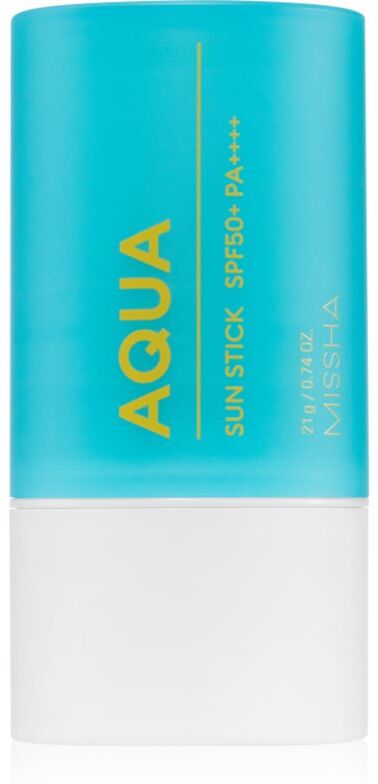
Missha All Around Safe Block Aqua Sun Stick crème solaire en stick pour une hydratation intense SPF 50+ 21 gMissha All Around Safe Block Aqua Sun Stick, 21 g, Protection contre le rayonnement solaire pour femme, Protégez votre peau du vieillissement prématuré et des autres dégradations causées par le soleil. La peau délicate du visage est beaucoup plus sensible que celle du reste du corps. En outre, elle est exposée aux rayons du soleil toute l'année. C'est pourquoi il est important de ne pas sous-estimer sa protection. Le produit de bronzage Missha All Around Safe Block Aqua Sun Stick protège efficacement la peau de votre visage contre les rayons UV et vous aide ainsi à prévenir les coups de soleil ou l'apparition de taches pigmentaires et à diminuer l'élasticité de la peau, la perte de collagène et autres signes de l’âge. Le produit : apaise la peau irritée et rougie protège la peau contre les rayons UVA et UVB application pratique et hygiénique réduction des taches pigmentaires donne de la fraîcheur et de la luminosité à votre peau rétracte les pores dilatés hydrate intensément unifie le teint de la peau nourrit en profondeur Composition du produit : niacinamide : augmente l’éclat de la peau, réduit les taches pigmentaires, unifie le teint, lisse les irrégularités de texture, aide à renforcer la barrière cutanée protectrice et à améliorer ainsi le niveau d’hydratation de la peau acide hyaluronique : fixe une grande quantité d’eau et hydrate intensément adénosine – possède des propriétés apaisantes et prévient les démangeaisons produit végétalien Mode d’emploi : Appliquez le produit environ 30 minutes avant d’exposer la peau aux rayons du soleil. Remettez-en une couche si nécessaire.21,90 €*Shipping: 3,45 €Secure redirect to the provider
-
How do you prove surjectivity?
To prove surjectivity, you need to show that for every element in the codomain, there exists at least one element in the domain that maps to it. One way to do this is by taking an arbitrary element in the codomain and finding a pre-image for it in the domain. If you can find a pre-image for every element in the codomain, then the function is surjective. Another approach is to show that the range of the function is equal to the codomain, indicating that every element in the codomain is being mapped to. **
-
How can one show surjectivity?
One can show surjectivity by demonstrating that every element in the codomain has a preimage in the domain. This can be done by showing that for every y in the codomain, there exists an x in the domain such that f(x) = y. In other words, the function "covers" the entire codomain, leaving no elements without a preimage. This can be shown through direct proof, by finding the specific preimage for each element in the codomain, or through a more general argument, such as showing that the function is onto. **
-
How can one check images for surjectivity?
One can check images for surjectivity by examining whether the range of the function covers the entire codomain. To do this, one can analyze the function's output for different input values and determine if every element in the codomain is covered. If the function's image covers the entire codomain, then the function is surjective. Another approach is to use the definition of surjectivity, which states that for every y in the codomain, there exists an x in the domain such that f(x) = y. By verifying this condition for all elements in the codomain, one can determine if the function is surjective. **
-
What is the injectivity and surjectivity of compositions?
The injectivity of compositions refers to the property of a composition of functions where if the composition of two functions is injective, then the outer function is injective. Similarly, the surjectivity of compositions refers to the property where if the composition of two functions is surjective, then the inner function is surjective. In other words, the injectivity and surjectivity of compositions are related to the properties of the individual functions within the composition. **
Similar search terms for Surjectivity
-
Is there no injectivity or no surjectivity here?
There is no surjectivity here. Surjectivity means that every element in the codomain is mapped to by at least one element in the domain. In this case, there are elements in the codomain that are not being mapped to by any element in the domain, so the function is not surjective. **
-
Why do we need injectivity, surjectivity, or bijectivity?
Injectivity, surjectivity, and bijectivity are important concepts in mathematics because they help us understand the relationship between different sets and functions. Injectivity ensures that each element in the domain maps to a unique element in the codomain, which is useful for preventing information loss in functions. Surjectivity guarantees that every element in the codomain is mapped to by at least one element in the domain, ensuring that no information is left out. Bijectivity combines these two properties, providing a one-to-one correspondence between elements in the domain and codomain, making it easier to establish relationships and solve problems in various mathematical contexts. **
-
How can one formally prove injectivity and surjectivity?
To formally prove injectivity, one must show that for any two distinct elements in the domain, their images under the function are also distinct. This can be done by assuming two elements in the domain that map to the same element in the codomain, and then showing that this assumption leads to a contradiction. To formally prove surjectivity, one must show that for every element in the codomain, there exists at least one element in the domain that maps to it. This can be done by taking an arbitrary element in the codomain and finding a pre-image for it in the domain. This process must be repeated for every element in the codomain to establish surjectivity. **
-
What methods do you know to prove surjectivity?
One method to prove surjectivity is to show that for every element in the codomain, there exists at least one element in the domain that maps to it. This can be done by explicitly finding the pre-image of each element in the codomain. Another method is to use the concept of range and show that the range of the function is equal to the codomain. Additionally, one can use the contrapositive of the definition of surjectivity, which states that if there exists an element in the codomain that does not have a pre-image in the domain, then the function is not surjective. **
* All prices are inclusive of VAT and, if applicable, plus shipping costs. The offer information is based on the details provided by the respective shop and is updated through automated processes. Real-time updates do not occur, so deviations can occur in individual cases. ** Note: Parts of this content were created by AI.